Google is Paying to Build AI Agents
Google is investing heavily in AI agent infrastructure. Here is what that means for builders.
Google is investing heavily in AI agent infrastructure. Here is what that means for builders.
Free resources that teach AI better than most paid courses. Save your money.
Claude usage analytics tool breakdown — track tokens, costs, and optimize your AI spend.
MCP connector from Higgsfield enables mass ad creative generation with AI agents.


Another ChatGPT trend is here People are turning their profiles into cute crayon-style cartoons using ChatGPT. The idea is simple. Upload a screenshot of your profile, paste the prompt, and let the model redraw the whole page as if it was made with crayons on white paper. The result keeps the profile layout, but turns the details into a playful handmade version filled with sweet childlike elements. It works because the output feels personal, nostalgic, and instantly shareable. Would you try this with your own profile?

DeepSeek's Liang Wenfeng identifies continuous learning as the key missing piece on the path to AGI, and this article argues it cannot live inside model weights due to economics, opacity, and vendor lock-in. Instead, durable agent memory should be stored in portable, inspectable formats like markdown and git, with a cognitive runtime handling retrieval, promotion, decay, and identity separation. The article warns that naive summarized memory can make agents overconfident about wrong facts, proving that how memory is structured matters as much as what it stores.
See more
This paper benchmarks LLM personalization capabilities through a Bayesian Persuasion framework applied to sales outreach, releasing SDR-Bench with 6,279 customer success stories across 22 industries. Frontier LLMs and deep-research agents show a consistent personalization plateau, with no model statistically separating successful from unsuccessful outreach on a Fortune 100 cohort. A field deployment with 12 sales reps validated the framework, with 48% of model-generated content rated immediately useful and senior-expert agreement at Pearson 0.82.
See more
U.S. export controls now can shut off access to frontier AI models overnight, as demonstrated when the Commerce Department suspended Anthropic's Fable 5 and Mythos 5 for three weeks via unpublished letters. Meanwhile, Chinese open-weight models like Kimi K3, GLM-5.2, and DeepSeek are closing the capability gap to months rather than years and now process roughly 61% of tokens on OpenRouter. Companies must weigh U.S. export-control risk against Chinese-model legal exposure, as both come with distinct compliance tripwires with no neutral third option.
See moreLLM-INSTRUCT won the UZH Shared Task at ArgMining 2026 for paragraph-level argument mining in UN/UNESCO resolutions using open-weight models up to 8B parameters. The system narrows candidate tags via dense retrieval, applies constrained decoding, escalates uncertain cases to three-agent debate, and validates JSON schema output. Key lesson: reducing the decision space before generation improves both accuracy and robustness.
See more
Tabular foundation models can predict missing spreadsheet columns zero-shot, analogous to how LLMs complete text. On the TabArena benchmark, these models now outperform fully tuned gradient-boosted trees like XGBoost. The article includes an independent reproduction of the strongest open model and maps scenarios where XGBoost still holds an edge.
See moreThis paper isolates the mechanism behind the Muon optimizer's faster grokking on modular arithmetic, showing that orthogonalization (Newton-Schulz iteration) is the active ingredient while spectral-norm constraints alone provide no speedup over AdamW. Orthogonalizing optimizers reach generalization at ~3x lower spectral norm and settle into lower-norm solutions. Reducing Newton-Schulz iterations from five to one accelerates threshold crossing but makes the grokked solution fragile, while five iterations remain robust across learning rates. The authors release full training and analysis code.
See more
Vercel announces Claude Opus 5 is now available on AI Gateway, highlighting improvements in long-horizon agentic coding, multi-file refactors, vision tasks, and subagent coordination. The post covers configuration options including reasoning effort levels, fast mode, model fallbacks for safety classifier blocks, and Zero Data Retention compatibility, plus setup instructions for routing coding agents through the gateway.
See more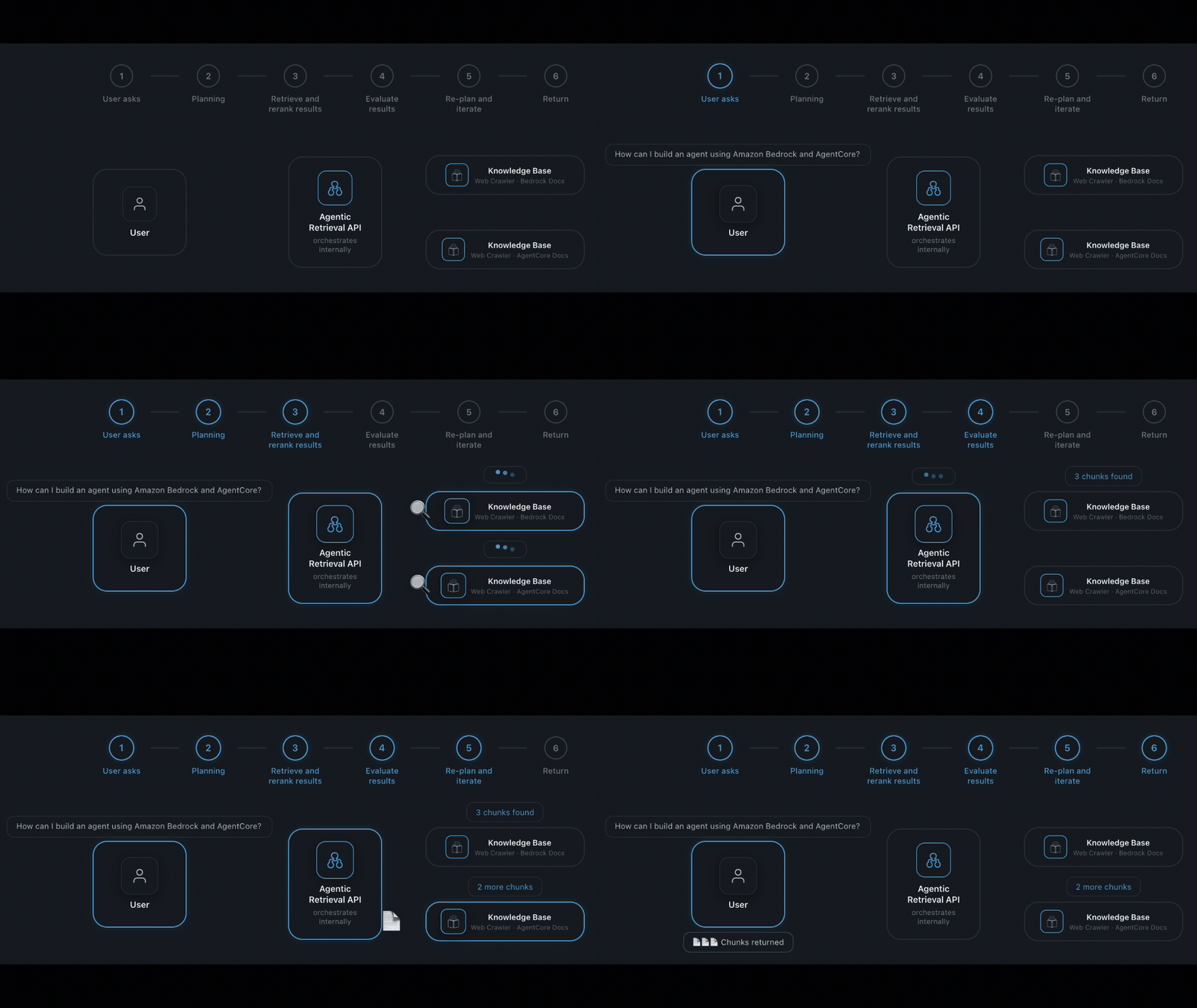
AWS introduces the AgenticRetrieveStream API for Amazon Bedrock Managed Knowledge Base, addressing shortcomings of classic retrieval on multi-part questions. The post covers request construction, trace parsing, and guidance on when to use agentic retrieval versus the standard Retrieve API. It targets developers building production RAG systems on AWS.
See more
Andrew Ng released OpenWorker, an MIT-licensed, local-first desktop AI agent that returns finished deliverables rather than chat replies. It runs a local Python agent server under a Tauri shell, supports 30 curated tool-calling models plus local Ollama, and gates every write, shell command, and off-machine action behind a typed risk engine for safe autonomous execution.
See more![SkewAdam: A tiered optimizer that cuts MoE state memory by 97% (fits a 6.7B MoE on a 40GB GPU) [R]](https://preview.redd.it/1457xi9fcqeh1.jpg?width=140&height=90&auto=webp&s=879aad6df9e51a2735d91112d01518ff76ba3cbe)
SkewAdam is a new tiered optimizer that cuts optimizer state memory for Mixture-of-Experts models by 97.4%, from 50.6 GB to 1.29 GB. It allocates precision based on parameter behavior: full state for backbone, factored 2nd moment for experts, and exact 2nd moment for routers. This enables a 6.7B MoE to train on a single 40GB GPU without sacrificing convergence or router stability.
See more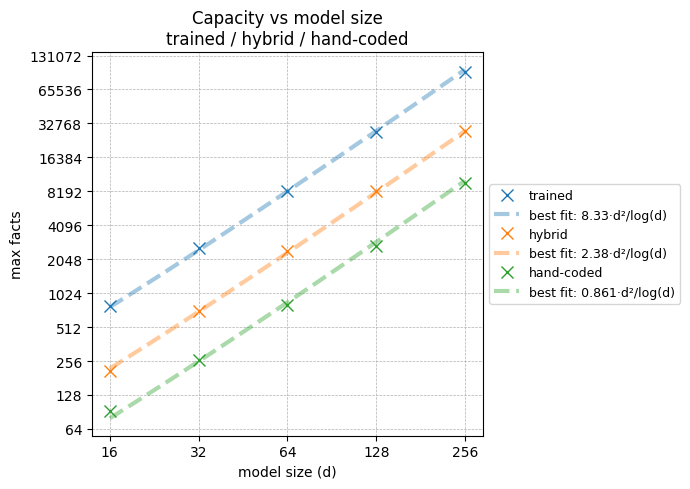
Researchers hand-coded weights for single-layer MLPs that memorize labels for two-token input sequences. The hand-coded models scale roughly linearly in memorization capacity with parameter count, matching trained models' scaling behavior. However, the scaling prefactor for hand-coded models still falls short of trained models by a significant factor, suggesting trained models use more efficient memorization strategies.
See more
Hugging Face announces integration of Nunchaku 4-bit quantization for diffusion model inference into the Diffusers library. This enables more memory-efficient generation of images using diffusion models with minimal quality loss. The post targets ML engineers and product teams deploying generative AI at scale.
See more
Google launched Gemini 3.5 Flash Cyber, a cost-efficient AI security model for finding and patching vulnerabilities, positioned as a cheaper alternative to larger models like Anthropic's Mythos. The model is available first to governments and trusted partners via CodeMender, Google's security-focused coding agent. It enables high-speed, low-cost scanning of more code paths by AI agents.
See more
Vercel unveiled eve, an open-source agent framework, alongside Vercel Connect (secure integrations), Vercel Agent (production monitoring), and enterprise governance tools with BYOC support on AWS. The London Ship 26 event introduced a complete stack for building, deploying, and managing AI agents at enterprise scale. Developers can start experimenting with npx eve@latest.
See more
Colin Francis from LangChain demonstrates Dynamic Subagents in Deep Agents, enabling programmatic orchestration of parallel agents through code instead of agent coordination. The video walks through six production patterns—Classify and Act, Fan Out and Synthesize, Adversarial Verification, Generate and Filter, Tournament, and Loop Until Done—with live LangSmith traces for each. This approach provides reliable multi-agent scaling with deterministic control flow.
See more
Tau is a minimal, educational Python coding agent from Hugging Face, designed as a readable reference for learning agent architecture. The video covers installation, a three-layer design pattern (tau_ai for model streaming, tau_agent for the loop harness, tau_coding for tools and TUI), model provider configuration, and durable session management. Install with `uv tool install tau-ai` and explore the open-source repo to understand how modern coding agents actually work.
See more
DeepSeek's DSpark uses semi-autoregressive speculative decoding to accelerate LLM inference 50–400% without retraining by having a small draft model propose token blocks while a large model verifies them in parallel. Overcomes limitations of prior autoregressive and parallel methods through improved block acceptance and confidence-scheduled verification. Production-ready with open-source DeepSpecs repo and validated on V4 models, Qwen, and Gemma.
See more
grok-loop-kit is an open-source Node and Python library that automatically manages context compaction for xAI's Grok 4.5 agents, calling the compaction endpoint at configurable turn or token thresholds to prevent context window overflow. The library handles xAI's exact compaction item format, integrates with LangGraph via a BaseChatModel adapter, and includes streaming, retries, and state management for durable agents. Adversarial testing confirms information preservation: 5/5 random vault codes were recalled exactly after four compaction cycles.
See more
Alex Reisner investigates how AI companies acquire and process training data from the open web, academia, and online platforms. The episode covers Common Crawl indexing, content filtering, and fair compensation debates. Core insight: training data acquisition remains the AI industry's least transparent and most ethically contested challenge.
See more
AWS Developers presents a layered defense approach to frontend security, covering XSS prevention, authentication/authorization, secrets management, npm supply-chain security, and AWS WAF. The presenter demos real vulnerabilities in a React app and fixes each layer step-by-step using AWS Cognito and IAM. Practical guide for building secure React applications with defense-in-depth architecture.
See more