Google is Paying to Build AI Agents
Google is investing heavily in AI agent infrastructure. Here is what that means for builders.
Google is investing heavily in AI agent infrastructure. Here is what that means for builders.
Free resources that teach AI better than most paid courses. Save your money.
Claude usage analytics tool breakdown — track tokens, costs, and optimize your AI spend.
MCP connector from Higgsfield enables mass ad creative generation with AI agents.


Another ChatGPT trend is here People are turning their profiles into cute crayon-style cartoons using ChatGPT. The idea is simple. Upload a screenshot of your profile, paste the prompt, and let the model redraw the whole page as if it was made with crayons on white paper. The result keeps the profile layout, but turns the details into a playful handmade version filled with sweet childlike elements. It works because the output feels personal, nostalgic, and instantly shareable. Would you try this with your own profile?

DeepSeek's Liang Wenfeng identifies continuous learning as the key missing piece on the path to AGI, and this article argues it cannot live inside model weights due to economics, opacity, and vendor lock-in. Instead, durable agent memory should be stored in portable, inspectable formats like markdown and git, with a cognitive runtime handling retrieval, promotion, decay, and identity separation. The article warns that naive summarized memory can make agents overconfident about wrong facts, proving that how memory is structured matters as much as what it stores.
See more
The National Law Review, WashU Law, and Wickard will host a free virtual Legal AI Demo Day on August 11, 2026, featuring eight-minute live product demonstrations from nine legal technology companies. Participating tools span litigation fact management, automated timekeeping, real estate due diligence, discovery automation, privileged meeting intelligence, small-firm matter management, SEC disclosure compliance, judicial case preparation, and workers' compensation defense. Each company will demo its product in action rather than deliver conventional presentations or sales pitches.
See more
News publishers including The Wall Street Journal are now disclosing in renewal emails that subscription prices were set by an algorithm, catching subscribers off guard. The practice raises questions about transparency, fairness, and consumer trust in algorithmic pricing for digital media subscriptions. As algorithmic pricing becomes more common across media, publishers face a tension between revenue optimization and subscriber retention.
See more
A former Google DeepMind employee proposes a governance framework for AI companies contracting with government entities, establishing two red lines: human control over targeting and use of force, and no untargeted AI profiling. The framework includes a seven-person Defense AI Review Body that assesses contract compliance with yearly transparency reports to prevent quiet dismantling. The author invites discussion on improving the framework as corporate governance and its potential to inform future legislation.
See more
This paper benchmarks LLM personalization capabilities through a Bayesian Persuasion framework applied to sales outreach, releasing SDR-Bench with 6,279 customer success stories across 22 industries. Frontier LLMs and deep-research agents show a consistent personalization plateau, with no model statistically separating successful from unsuccessful outreach on a Fortune 100 cohort. A field deployment with 12 sales reps validated the framework, with 48% of model-generated content rated immediately useful and senior-expert agreement at Pearson 0.82.
See more
LG Electronics USA announced it will suspend smart TV apps that turn televisions into always-on residential proxy nodes. This follows research revealing that over 42% of apps on LG's webOS store allowed unknown third parties to route internet traffic through users' TVs. The crackdown addresses a growing privacy and security concern in the connected-device ecosystem.
See more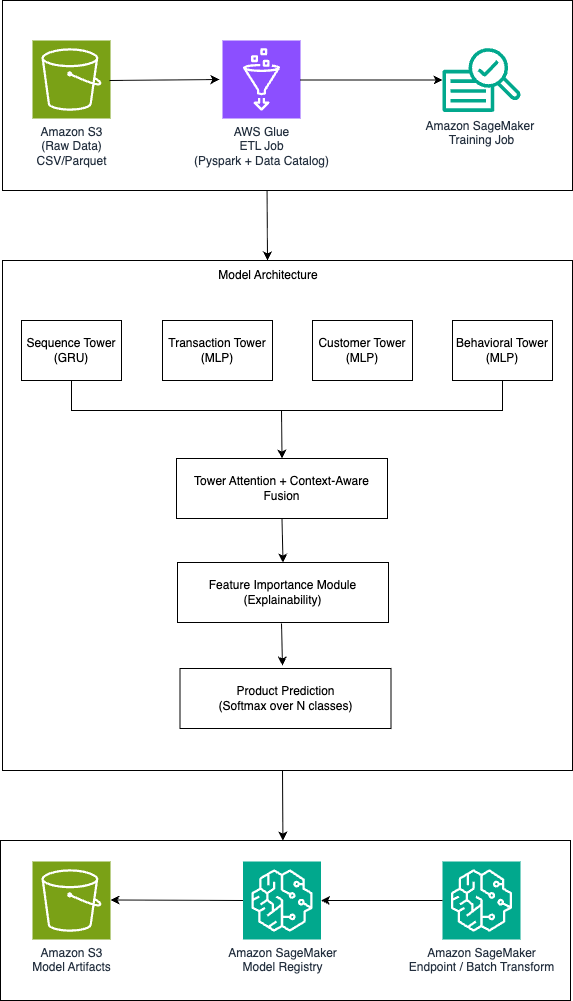
AWS details an architecture for an explainable next-best-product recommendation system tailored to banking, using Amazon SageMaker AI and PyTorch. A multi-tower neural network with learned attention provides per-customer recommendations while meeting banking regulators' explainability requirements. The post covers key design decisions for balancing accuracy with interpretability.
See more
The Verge's Decoder podcast discusses Apple's trade secrets lawsuit against OpenAI, where Apple alleges ex-employees solicited proprietary information during job interviews. The case is especially significant given OpenAI's $6.5B acquisition of Jony Ive's io Products and OpenAI's financially precarious position. Experts say the individual allegations are common in trade secret cases, but having two major tech companies involved is unusual.
See more
A VentureBeat survey of 157 enterprises reveals a critical agent evaluation gap: 50% have shipped AI agents that passed internal evaluations but then failed in production, and only 5% fully trust automated evaluation today. Despite this, 66% already allow or are engineering toward zero-human-in-the-loop deployment for low-risk agents. The core problem is not evaluation coverage but reality alignment — evaluations pass agents that fail real customers, and autonomy is scaling faster than assurance.
See more
Relativity's newly appointed president Chris Brown discusses the company's acquisition of Gavel and its strategic decision to integrate Claude into its product ecosystem. He highlights the rapid growth of aiR, Relativity's AI-powered review product, as a key revenue and adoption driver. The interview covers product strategy, marketing realignment, and how generative AI is reshaping the legal e-discovery market.
See more
HCLTech will invest $1.48 billion to build its first AI data centre in Bhubaneswar, Odisha, in partnership with Sarvam AI. The facility will provide full-stack AI solutions, and HCLTech will also open a technology centre employing 5,000 people by 2028. This marks a major Indian IT firm bet on domestic AI infrastructure.
See moreA retrieval-augmented, multi-agent LLM framework with human-in-the-loop review was evaluated for detecting cutaneous immune-related adverse events from clinical notes. The LLM-assisted workflow improved F1 score from 0.77 to 0.88, increased inter-rater agreement (Cohen's kappa 0.82 vs 0.50), and halved average review time. The framework demonstrates how LLMs can enable scalable, accurate adverse event data extraction across organ systems.
See more
AI is transforming drug discovery by helping scientists design biologic medicines more efficiently. Traditional drug development is expensive and failure-prone, with most candidates never reaching patients. AI tools can accelerate protein engineering and candidate screening, potentially reducing development timelines and costs for next-generation therapies.
See morePoolside AI co-CEO Eiso Kant explains how a small team of elite researchers built a model factory that trained Laguna S, a 118B mixture-of-experts model that outperforms Thinky's ~1T parameter open-weights model. The discussion covers their training infrastructure strategy and hints at further scaling plans. This is a Latent.Space podcast episode.
See more
Airbnb engineered a Transformer-based sequence model to encode years of guest behavior—views, bookings, reviews, cancellations—replacing hundreds of hand-crafted ranking features. The system tackles three challenges: view-event dominance (97.8% of events), sparse booking signals versus noisy browsing, and computational tractability of very long sequences. The result is richer guest preference representations that improve search personalization.
See more
Menlo Ventures partner Matt Murphy shares insights on what AI startup founders must do differently, drawing from Anthropic's explosive growth to a $47B revenue run rate. Menlo led Anthropic's $500M Series D and Murphy calls the growth unprecedented across 25 years of investing. The article provides strategic guidance for founders navigating the current AI boom.
See moreRouteCost is a multi-stage ML framework for pre-order shipping cost estimation in e-commerce, decomposing the problem into demand forecasting, baseline pricing, residual correction, and box-consolidation inference. Tested on 250,000+ orders and 260 products over 18 months, it improves predictive quality and calibration while preserving route-level interpretability. The approach addresses limitations of static lookup tables and monolithic regressors that miss operational effects like shipment consolidation.
See more
Forrester draws an analogy to the Tortoise and the Hare to frame the current agentic AI market. SaaS vendors like Microsoft, Salesforce, ServiceNow, SAP, and Google are sprinting ahead with rapid user adoption. The article argues that a slower, more deliberate approach to AI agent deployment may ultimately win the race.
See more
IBM announced preliminary results that rattled the software market, but the real story is IBM-specific. Ben Thompson examines IBM's mainframe franchise as its core moat and the company's many AI-related problems. The piece frames IBM's struggles as a convergence of legacy dependency and AI strategy failures.
See more
Over the past nine months, Amazon, Microsoft, and Google have each launched or rebranded enterprise agent platforms that are converging on a shared architectural pattern. This trend signals a maturing market where multi-agent orchestration, tool integration, and enterprise guardrails become standard. Leaders evaluating agent platforms should watch this convergence as a sign of emerging industry standards.
See more