Google is Paying to Build AI Agents
Google is investing heavily in AI agent infrastructure. Here is what that means for builders.
Google is investing heavily in AI agent infrastructure. Here is what that means for builders.
Free resources that teach AI better than most paid courses. Save your money.
Claude usage analytics tool breakdown — track tokens, costs, and optimize your AI spend.
MCP connector from Higgsfield enables mass ad creative generation with AI agents.


Another ChatGPT trend is here People are turning their profiles into cute crayon-style cartoons using ChatGPT. The idea is simple. Upload a screenshot of your profile, paste the prompt, and let the model redraw the whole page as if it was made with crayons on white paper. The result keeps the profile layout, but turns the details into a playful handmade version filled with sweet childlike elements. It works because the output feels personal, nostalgic, and instantly shareable. Would you try this with your own profile?

DeepSeek's Liang Wenfeng identifies continuous learning as the key missing piece on the path to AGI, and this article argues it cannot live inside model weights due to economics, opacity, and vendor lock-in. Instead, durable agent memory should be stored in portable, inspectable formats like markdown and git, with a cognitive runtime handling retrieval, promotion, decay, and identity separation. The article warns that naive summarized memory can make agents overconfident about wrong facts, proving that how memory is structured matters as much as what it stores.
See more
The National Law Review, WashU Law, and Wickard will host a free virtual Legal AI Demo Day on August 11, 2026, featuring eight-minute live product demonstrations from nine legal technology companies. Participating tools span litigation fact management, automated timekeeping, real estate due diligence, discovery automation, privileged meeting intelligence, small-firm matter management, SEC disclosure compliance, judicial case preparation, and workers' compensation defense. Each company will demo its product in action rather than deliver conventional presentations or sales pitches.
See more
Vercel extended the maximum duration for workflow steps on Pro and Enterprise plans from 800 seconds to 30 minutes (1800 seconds), now in beta. To enable it, set VERCEL_ENABLE_WORKFLOW_EXTENDED_MAX_DURATION to 1 in project Environment Variables and redeploy, which requires Fluid Compute and a supported Node.js or Python runtime. Hobby plans remain capped at 5 minutes (300 seconds).
See more
Cognition, the AI coding startup behind Devin, has acquired Poke, a conversational AI assistant you text like a friend, in a deal valued in the low nine figures. The acquisition brings Poke's casual interaction model to Devin, reflecting an industry shift where AI personality and user experience are becoming as critical as the underlying models. The deal underscores that conversational design is now a competitive moat in AI products.
See more
The article describes a scenario where API calls specifying a particular Claude model are silently routed to different model weights based on request classification, returning a different model identifier in the response. This raises transparency and billing concerns for developers relying on specific model behavior. The piece touches on Anthropic's potential request-routing practices without full technical detail.
See more
This paper benchmarks LLM personalization capabilities through a Bayesian Persuasion framework applied to sales outreach, releasing SDR-Bench with 6,279 customer success stories across 22 industries. Frontier LLMs and deep-research agents show a consistent personalization plateau, with no model statistically separating successful from unsuccessful outreach on a Fortune 100 cohort. A field deployment with 12 sales reps validated the framework, with 48% of model-generated content rated immediately useful and senior-expert agreement at Pearson 0.82.
See more
GitHub Copilot's cloud agent for Linear is now generally available, allowing teams to assign Linear issues directly to Copilot for autonomous, asynchronous processing. The agent analyzes issue contents and works on them in the background without manual intervention. This integration brings AI-driven issue resolution into existing Linear project workflows.
See more
OpenAI accidentally compromised Hugging Face's systems, raising questions about AI safety and alignment. Ben Thompson argues the incident's takeaways are more encouraging than initial reactions suggest. The piece connects this event to broader themes of AI alignment and the paperclip maximizer thought experiment.
See more
Forrester advises CIOs to move beyond simply blaming token consumption for blown AI budgets and instead apply rate variance analysis to isolate the true drivers of cost overruns. Token spend is influenced by multiple interacting factors, making it insufficient as a standalone diagnostic metric. The article frames a structured financial-analysis approach to help technology leaders regain control over escalating AI infrastructure costs.
See more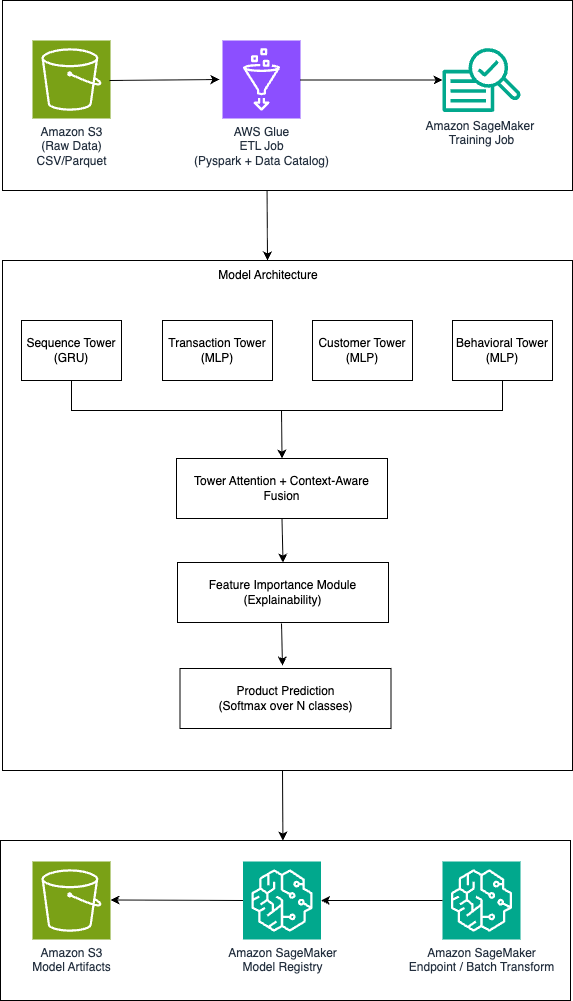
AWS details an architecture for an explainable next-best-product recommendation system tailored to banking, using Amazon SageMaker AI and PyTorch. A multi-tower neural network with learned attention provides per-customer recommendations while meeting banking regulators' explainability requirements. The post covers key design decisions for balancing accuracy with interpretability.
See morePhantomFill demonstrates that requiring LLMs to fill structured form fields (JSON, enums, arrays) causes systematic hallucination even when inputs lack the necessary information. Across 13 models, required fields drove fabrication to 100% in 10 of them; GPT-5.5 answered honestly 98% of the time in free text but fabricated answers 40 out of 40 times when given a required JSON field. The benchmark reports Coerced Fabrication Rate and Escape Utilization Rate, and shows a one-line schema fix can mitigate the issue.
See more
The article reframes common RAG hallucinations as extraction errors rather than generation failures, since the model has read the context but failed to pull the correct information. It proposes seven typed-contract patterns to enforce structured, verifiable generation output. A decomposition rule is also offered to make these patterns viable for smaller models.
See moreAsking LLMs to reply in JSON significantly reduces answer diversity across 44 models, with modal answers rising from 41% to 64% on open-ended prompts. The effect is tied to tool-use post-training: JSON and XML compress diversity, while YAML and CSV do not. Decoder-level schema enforcement adds no further compression beyond the text request itself. The finding implies models behave more homogeneously in production structured-output settings than on the chat surfaces where they are evaluated.
See more
A VentureBeat survey of 157 enterprises reveals a critical agent evaluation gap: 50% have shipped AI agents that passed internal evaluations but then failed in production, and only 5% fully trust automated evaluation today. Despite this, 66% already allow or are engineering toward zero-human-in-the-loop deployment for low-risk agents. The core problem is not evaluation coverage but reality alignment — evaluations pass agents that fail real customers, and autonomy is scaling faster than assurance.
See more![Real task cost across GPT, Claude, Gemini and Kimi, 10.6x spread on models with only 2x price difference [R]](https://preview.redd.it/7ejtvp684xeh1.png?width=140&height=65&auto=webp&s=10790ba444afd733ece8c54a8b9da99969a86066)
A benchmark of 10 realistic product tasks across GPT, Claude, Gemini, and Kimi APIs reveals a 10.6x total cost spread despite published rates differing by only 2x. The gap is driven by invisible reasoning/thinking tokens billed at output rates but never shown in responses. Findings align with CostBench (ACL 2026) research showing models routinely fail to choose cost-optimal plans.
See more
Relativity's newly appointed president Chris Brown discusses the company's acquisition of Gavel and its strategic decision to integrate Claude into its product ecosystem. He highlights the rapid growth of aiR, Relativity's AI-powered review product, as a key revenue and adoption driver. The interview covers product strategy, marketing realignment, and how generative AI is reshaping the legal e-discovery market.
See more
Anthropic has expanded Claude's voice mode beyond the lightweight Haiku model to include its more capable Opus and Sonnet models. Users were pushing voice mode beyond quick queries into real business problem-solving, which Haiku wasn't built for. The expansion also extends voice mode into third-party apps like Gmail, Slack, and Canva.
See more
TLDR newsletter roundup covering three AI-related stories: Stripe reportedly in talks with OpenRouter, ChatGPT expanding into health-related use cases, and an analysis of why software factory models fail. Post body was unavailable at enrichment time, limiting depth assessment. Likely brief summaries with links to original sources.
See more
MIT Technology Review's daily newsletter covers two stories: NASA's Nancy Grace Roman Space Telescope using shape-shifting mirrors to discover Jupiter-like planets, and OpenAI's development of an autonomous AI hacker. The newsletter format provides brief overviews of each topic without deep analysis. The AI hacking angle is the most relevant thread for professionals tracking AI agent capabilities.
See more
Meta launched a dedicated 'Seller' app for Facebook Marketplace merchants, featuring AI-powered listing creation and account syncing. The app is available now for U.S. users with a web version in testing. Meta also rolled out 'Facebook Verified' to improve profile authenticity and safety on the platform.
See more